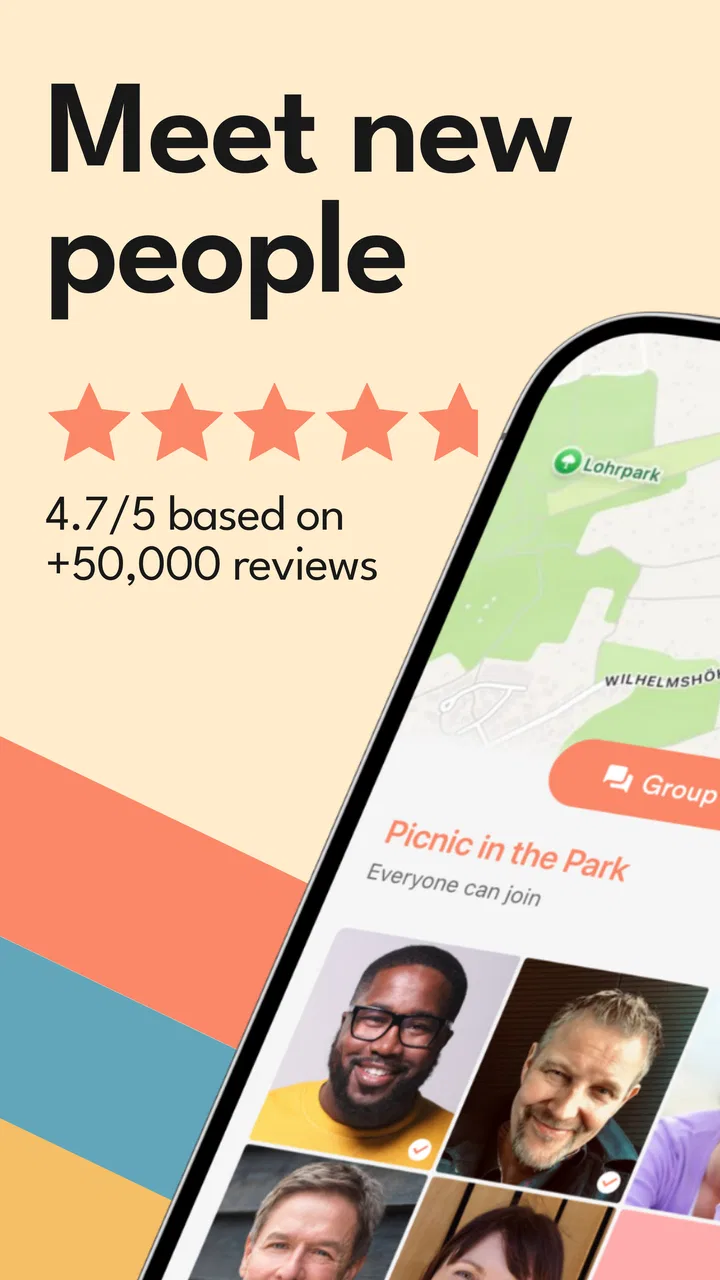
Meet5: Meet new people
- 4.4
- Rating
- 1.00M
- Installs
- Free
- Price

 Analysis by App-foxy
I approached Meet5 as a lifestyle app for people who want to move beyond passive scrolling and actually meet others through shared activities. Developed by Meet5 GmbH, it focuses on making new connections in a group setting rather than treating every interaction like a private conversation or a traditional dating match. That difference affects almost everything: how you browse, how you decide whether an event feels comfortable, and how much effort you need to put in before an online connection becomes an in-person one.
My overall impression is that the concept makes sense for adults who are new to an area, working from home, rebuilding a social routine, or simply tired of waiting for friendships to happen by accident. It is free to install and aimed at a Teen audience, although the real usefulness depends less on age and more on confidence, mobility, communication preferences, and access to suitable activities. The app has reached over a million installs and holds an average rating of 4.2 from around forty thousand ratings, which suggests that the basic idea resonates with a substantial audience.
How Meet5 feels to use when you need clear, manageable choices
I find Meet5 easiest to approach when I treat it as a way to choose one manageable social plan, rather than as another feed I need to keep checking. In this section, I focus on how narrowing the decision to an activity can make joining feel less daunting; next, I’ll look at what that choice involves once it becomes a real outing.
You May Also Like

 Blood Strike: 2.5 Anniversary
Blood Strike’s Loadouts Turn Every Drop Into a Tactical Gamble
A close look at Blood Strike’s custom loadouts: how fast access to signature weapons reshapes its battle royale rhythm, rewards preparation, and narrows the gap between fights.

 Pandora - Music & Podcasts
Pandora’s Music Is Easy to Start, but Harder to Recover
Pandora’s strength is its low-effort path from a seed to a station. Its weak spot is how much confidence it asks you to place in connection, setup, and quiet recovery.

 8 Ball Pool
 Is Built on Rivalries, Rematches, and Routine
A close look at the rivalries, rematches, shared routines, and unanswered safety questions that turn a quick pool match into a persistent mobile community.

 Samsung Music
’s Quiet Strength Is Playing What You Already Own
Its reach comes less from spectacle than from dependable access to a personal library. That simplicity is both the app’s strongest retention engine and its ceiling.

 AccuWeather: Weather Radar
AccuWeather Review: A Quick, Clear Forecast for Everyday Decisions
For everyday plans, the best forecast is the one you can understand quickly. AccuWeather makes rain timing, radar, and local conditions easy to act on, with a few trade-offs.

 Hill Climb Racing
Why Hill Climb Racing Still Turns Crashes Into One More Run
A tiny car, a bumpy hill and one more upgrade: Hill Climb Racing keeps resurfacing because its simple chaos makes every near-miss feel personal.
More From Our News Desk



Readability and navigation
The most important design question for this kind of service is not whether it looks attractive; it is whether I can quickly understand what is happening and what I am expected to do next. A social discovery app can become tiring when every screen presents too many profiles, invitations, messages, and event details at once. Meet5 is easier to judge when I treat it as an activity-finding tool first and a social network second. That mindset makes the journey more concrete: look for something appealing, inspect the context, and decide whether joining feels realistic.
I found that this approach is particularly helpful for people who dislike open-ended networking. Instead of starting with “Who should I message?”, the more useful question becomes “Which activity would I genuinely enjoy attending?” That small shift lowers the pressure. It also gives a conversation an immediate subject, because people are arriving around a shared plan rather than trying to invent a connection from an empty chat.
For users who need larger text, stronger contrast, or more time to process information, the practical test is whether the phone’s own display and accessibility settings make the interface comfortable. I would not assume that every label, image, or control will remain equally easy to interpret after increasing text size, so I recommend checking the main browsing and participation screens before committing to an event. The app is most approachable when you can identify the activity, timing, location, and participation state without repeatedly guessing what each control means.
There is also a useful distinction between readability and social clarity. Even if the words on a screen are easy to read, an event may still feel unclear if its expectations are vague. I would look for enough context to answer basic questions before joining: Is this something I can reach comfortably? Will I be expected to talk constantly? Does the activity provide natural breaks? A well-matched event can make the app feel simple, while a poorly matched one can make the same interface feel demanding.
Why group activities can be easier than one-to-one matching
Compared with dating apps or ordinary social networks, Meet5 places more weight on a shared activity. That is a meaningful advantage for people who find direct approaches uncomfortable. In a one-to-one service, a declined message can feel personal and the conversation may depend entirely on two strangers carrying it. A group activity distributes that pressure. I can speak with several people, listen before joining in, and let the setting provide some of the conversation.
This does not make socializing effortless. I still need to choose an event, show up, and tolerate a certain amount of uncertainty. However, the structure gives me more ways to participate. I can ask a practical question, comment on the activity, or respond to someone nearby without having to present a polished version of myself in a private chat.
A realistic example would be someone who has recently moved for work and spends most evenings alone. Rather than searching a broad social network and sending messages to strangers, they could use Meet5 to identify an activity that fits an existing interest. Their first goal does not need to be finding a best friend. It can simply be attending once, learning how the group feels, and deciding whether the format suits them. That is a healthier and more achievable first step.
Motor and sensory considerations before joining an activity
Accessibility is not only about the app’s screens. In Meet5, the event itself is part of the user experience, so physical and sensory demands deserve attention before I commit. A walk, a busy restaurant, an outdoor gathering, or an activity with background noise can be comfortable for one person and exhausting for another. The app can help initiate the connection, but I still need to evaluate the real-world setting carefully.
For someone with limited stamina, pain, balance concerns, or a mobility aid, the key trade-off is between social opportunity and logistical uncertainty. An activity may sound welcoming but still involve stairs, long distances, crowded entrances, or limited seating. I would contact the organizer or group before attending if the listing does not make those details clear. That is not being difficult; it is a sensible way to avoid arriving somewhere that cannot meet basic needs.
People with hearing differences may also want to think beyond whether an event is labeled social. A large group in a noisy venue can be much harder than a smaller gathering in a quiet place. I would favor activities with a clear central focus, predictable turn-taking, or an environment where it is possible to move closer to the conversation. If I need communication adjustments, asking about them in advance is more reliable than hoping the group will notice during the event.
Sensory sensitivity creates a similar issue. Crowds, bright lighting, strong smells, unpredictable noise, and rapid changes in plans can turn a promising activity into an unpleasant experience. The most useful strategy is to start with a lower-intensity event and treat the first meeting as a trial rather than a commitment to a new social identity. Bringing a simple exit plan, such as knowing how to leave independently, can make participation feel safer and more manageable.
For users with visual impairments, screen-reader behavior, image descriptions, and the clarity of event information matter. I would test the app with the accessibility tools already used on the phone and make sure essential details can be reached without relying only on visual cues. If an event depends heavily on recognizing people from photos or navigating an unfamiliar location, I would arrange a clear meeting point and communicate that preference beforehand.
Situational access: when the app is useful and when it is not
Meet5 is especially relevant during life changes. Moving to a new city, starting remote work, leaving school, retiring, or recovering from a long period of isolation can all make ordinary friendship-building feel strangely difficult. Existing friends may be busy, while local groups can be hard to discover or intimidating to enter alone. A service built around activities gives me a practical reason to attend instead of asking me to announce that I am lonely.
It can also suit people who prefer recurring social habits. One isolated meeting may be pleasant but forgettable. If I find an activity type and group atmosphere that work for me, repeating that pattern can create familiarity. The first event becomes less important because I know what to expect next time, and recognizing a few faces can reduce the mental energy required to start conversations.
The app is less suitable for someone who wants fully private, carefully controlled interaction from the beginning. If your priority is extensive profile filtering, long written conversations, or choosing one person at a time, a conventional dating or friendship platform may feel more precise. Meet5’s group orientation is its identity, but that also means I have less control over the exact social mix and the pace of an encounter.
It may also be a poor fit when transportation, health, caregiving, work schedules, or anxiety make in-person attendance unreliable. The app can help locate an opportunity, but it cannot remove the cost of getting there or guarantee that an event will feel comfortable. I would not use it as a substitute for online communities if leaving home is currently difficult. In that situation, a remote-first service may offer more dependable access.
A practical workflow for a first meeting
My advice is to avoid treating the first event as a major test of your social ability. Begin by choosing something you would enjoy even if the conversation were only average. That gives you a meaningful reason to attend and prevents the entire experience from depending on whether you instantly connect with someone.
Before joining, I would check the route, expected duration, venue layout, noise level, weather exposure, and whether there is an easy way to leave. I would also prepare one or two simple questions related to the activity. This is more useful than memorizing conversation starters because it keeps the interaction grounded in what everyone is doing.
On arrival, a short introduction is enough. I do not need to explain my entire background or announce that I am trying to make friends. Saying that it is my first time attending and asking how the activity usually works creates an opening without putting too much pressure on either person. If the group feels welcoming, I can stay longer; if it feels wrong, leaving politely is a valid outcome rather than a failure.
One non-obvious benefit of this workflow is that it lets me evaluate the group’s behavior, not just the advertised activity. Do people make room for newcomers? Do they speak over one another? Is there patience when someone needs clarification? These details tell me more about inclusive social access than a polished event description can. I would use the first meeting to assess the community as carefully as it assesses me.
Safety, boundaries, and the cost of convenience
Meeting people through an app always requires ordinary personal safety habits. I would choose a public setting, tell someone I trust where I am going, and keep control of my own transport. I would avoid sharing sensitive personal information too quickly, even if a conversation feels friendly. The group format can provide reassurance, but it is not a reason to switch off judgment.
There is also a social boundary that is easy to overlook: joining an activity does not mean I owe anyone continued contact. I can attend once, decline a private invitation, or leave a conversation that makes me uncomfortable. People who are new to group platforms may feel pressure to be agreeable because they do not want to seem unfriendly. In my view, clear boundaries make participation more sustainable.
The app itself is free to use in the basic sense that there is no purchase required to install it. Optional in-app purchases range from $0.99 to $219.99 per item, so I would inspect any upgrade screen carefully and decide whether a paid option solves a problem I actually have. The existence of optional purchases is not automatically negative, but it means I would not assume every useful-looking action is part of the no-cost experience.
That pricing range also changes how I would recommend the app to a cautious user. Start without spending money, learn whether suitable activities appear in your area, and see whether the social format fits your personality. Paying before answering those questions would reverse the sensible order. The value comes from finding realistic opportunities, not from owning more app features in the abstract.
Remaining barriers for different users
The biggest barrier is likely to be local relevance. A service can have a strong overall community and still feel empty or repetitive in a particular area. If nearby activities do not match your interests, schedule, language, energy level, or access needs, the app cannot compensate through design alone. I would judge it by the quality and practicality of the opportunities visible to me, not only by its broad popularity.
Another barrier is the gap between digital information and real-world inclusion. An event may welcome newcomers but not clearly communicate whether the venue has step-free access, quiet space, accessible toilets, seating, or a predictable schedule. Users with disabilities should not have to guess, and organizers who want broader participation would benefit from describing these details directly. Until that information is consistently clear, some people will need to ask additional questions before feeling able to join.
There is a psychological barrier too. Group activities can be less intimidating than one-to-one matching, but they are still public. Someone experiencing severe social anxiety may find the first arrival, introductions, and uncertainty overwhelming. I would recommend using the app gradually: browse first, choose a familiar type of activity, attend with a trusted companion if appropriate, and leave room for recovery afterward. If the platform makes you feel constantly evaluated, it may not be the right tool at this stage.
People who need asynchronous communication may also find the format limiting. Meet5 is built around turning discovery into participation, so it is naturally more useful to those who can eventually attend in person. A text-based community, moderated forum, or interest group may be better for someone who wants to build trust slowly through writing. That is not a criticism of the app; it is a reminder that different forms of access require different social pacing.
Finally, the Teen content rating means younger users may encounter a service that feels socially mature in practice, with real-world meetings and adult responsibilities around transport and boundaries. I would encourage younger people to involve a trusted adult when appropriate and to be especially careful about meeting anyone they do not know. The rating should not be treated as a guarantee that every situation will suit every age or level of independence.
What the current app suggests about long-term usefulness
The current version is 2026.5.15, and the app has been available since May 20, 2019. That history matters because a social platform needs time to develop recognizable habits and a user base, but longevity alone does not guarantee that it will be active where I live. I would still test the local experience directly rather than assuming that a large install count translates into nearby options.
Meet5’s strongest long-term possibility is helping users turn occasional attendance into a routine. The first benefit may be simple discovery, while the deeper value comes from repeated contact with people who share an interest. That is a slower form of connection than matching with someone instantly, but it can feel more natural because friendship grows around actual time spent together.
At the same time, the group model can create uneven experiences. One event may be warm and inclusive, while another may leave a newcomer on the edge of the conversation. I would not judge the entire service by one meeting, but I also would not ignore a pattern. Try different activity types, notice which formats support your communication style, and keep the ones that make participation feel sustainable.
My inclusive verdict
I recommend Meet5 to people who want a practical bridge from online discovery to in-person social life, especially when shared activities feel more comfortable than direct messaging. Its group-centered approach can reduce the awkwardness of approaching one stranger and gives conversations an immediate context. For someone rebuilding a routine, moving somewhere new, or looking for friendship without the pressure of dating, that is a meaningful strength.
I would recommend it with a more careful approach to accessibility. The app can open doors, but the event, venue, transportation, noise, pace, and group culture determine whether those doors are genuinely usable. Check details, ask direct questions, choose a manageable first activity, and keep an independent exit plan. Those steps are not extra work around the experience; they are part of making the experience work for you.
My final view is that Meet5 is most valuable when you use it as a tool for deliberate, low-pressure experiments in connection. It is not the best choice for people who need entirely remote interaction, highly controlled one-to-one matching, or guaranteed accessibility information before deciding. For everyone else, its free starting point makes it reasonable to explore, provided you judge the actual local activities and do not spend on optional purchases until the basic social experience has earned your trust.
FAQs for Meet5: Meet new people
01What is Meet5 and how does it work?
Meet5 is a social networking app designed to help users meet new people in a casual group setting. Instead of one-on-one meetings, it organizes group outings, making it easier and safer to connect with others. Users can join existing groups or create their own, choosing from various activities or social events.
02Is Meet5 safe to use?
Meet5 prioritizes user safety by encouraging group interactions rather than individual meetups. The app includes features such as user verification and reporting tools. Additionally, all users can view profiles of group participants before joining, ensuring a transparent and secure social experience.
03Do I need to pay to use Meet5?
Meet5 is free to download and use with basic features. However, it offers premium options for users seeking enhanced functionalities like unlimited group participation or advanced filters. These features require a subscription, providing more flexibility and opportunities to connect with others.
04Can I customize my Meet5 profile?
Yes, users can personalize their Meet5 profiles by adding photos, interests, and a short bio. This helps others get to know you better and increases the chances of joining groups with similar interests. The app also allows you to update your location to find local events and outings.
05How can I find groups or events on Meet5?
Finding groups or events is simple. After setting your location and preferences, the app presents a list of available outings. Users can filter these by activity type or date. You can also create your own group event if you have a specific idea or activity in mind.
Pros
- Easy-to-use interface for quick navigation.
- Profile customization enhances user experience.
- Location-based matches increase relevance.
- Free features available for basic use.
- Secure login protects user privacy.
Cons
- Limited matches in less populated areas.
- Premium features require subscription.
- Occasional bugs in chat functionality.
- Notifications can be overwhelming.
- Profile verification can be slow.

Meet5: Meet new people
Gallery